
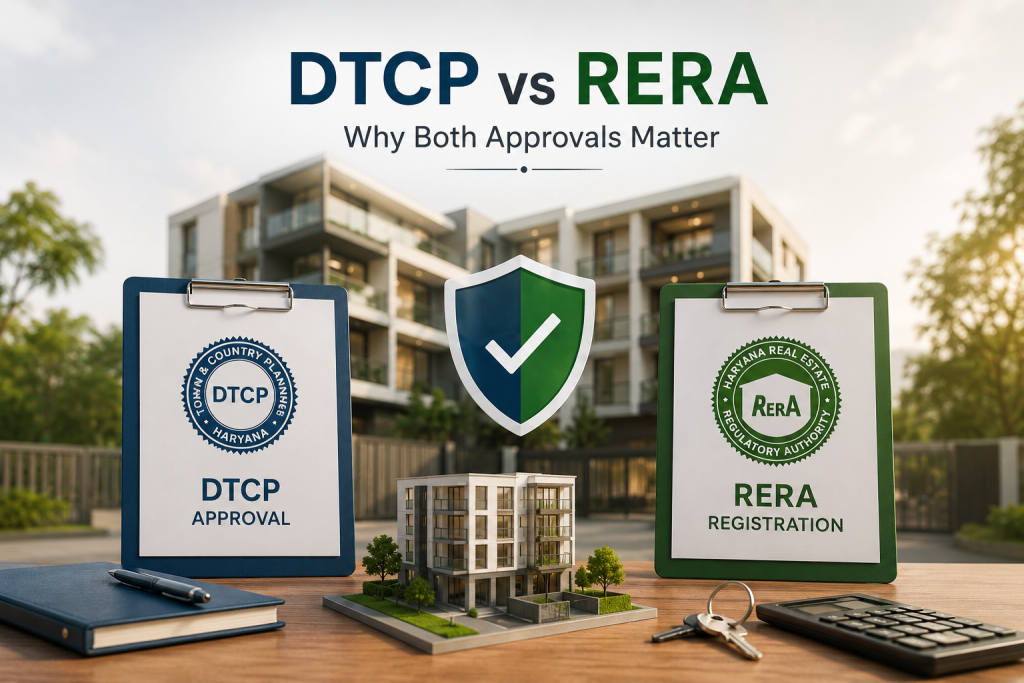
Brokers throw both terms around constantly. “DTCP approved,” “RERA registered” — buyers nod along, assuming the two mean roughly the same thing. They don’t. They cover completely different parts of a project, and skipping either one leaves a real gap in your protection.
Let’s clear this up properly.
What DTCP Actually Checks
DTCP stands for the Department of Town and Country Planning, Haryana’s authority that governs how land gets used and developed across the state. Before a developer builds anything, they need DTCP approval for the layout plan — road widths, plot sizes, green spaces, and whether the land itself is legally cleared for residential or commercial construction.
Think of DTCP approval as permission to build in the first place. It confirms the land use is legal, the layout meets planning norms, and the developer followed the right process to convert raw land into an approved residential colony or plotted development.
What RERA Actually Checks
RERA, the Real Estate Regulatory Authority, works differently. It doesn’t approve the land use itself. It regulates how developers sell, market, and deliver a project once construction is underway or planned. A RERA-registered project has disclosed its estimated cost, its promised completion date, its sanctioned plan, and the developer’s own track record on past projects.
RERA exists mainly to protect buyers after money changes hands. If a developer misses the promised delivery date or misrepresents the project, RERA gives you a formal channel to file a complaint and seek compensation.
Why You Need Both, Not Just One
Here’s where buyers get tripped up. A project can have RERA registration without proper DTCP approval, and technically, that shouldn’t happen — but gaps in enforcement do occur, especially with smaller or newer developers. A RERA number gives you a complaint mechanism, but it doesn’t retroactively fix an illegal land use violation underneath it.
The reverse also happens. A project might have clean DTCP approval for its layout but skip RERA registration entirely, especially older or smaller projects that predate stricter enforcement. Without RERA, you lose access to the regulator’s disclosure requirements and complaint process if something goes wrong during construction or delivery.
You genuinely need both stamps of approval working together. DTCP confirms the land and layout are legitimate. RERA confirms the sale process itself is transparent and accountable.
How to Check Both Before You Buy
Ask your developer directly for the DTCP license number and the RERA registration number — both should be readily available, usually printed on brochures or the project’s official documents. Don’t stop at just seeing the numbers, though.
Verify the DTCP approval through Haryana’s town planning department records, and cross-check the RERA number on the HRERA portal. The portal shows the promised completion date, the developer’s other registered projects, and any complaints filed against them. A legitimate project has nothing to hide here, and a developer who hesitates to share either number is telling you something important without saying a word.
What Happens If a Project Is Missing One
If a project has RERA but no clear DTCP approval, tread carefully. That usually signals the underlying land use hasn’t been fully regularized, which can create serious problems later — from construction restrictions to outright demolition risk in extreme cases.
If a project has DTCP approval but no RERA registration, you lose the regulatory safety net for delays or misrepresentation, even if the land itself is completely legitimate. Older, well-established developers sometimes fall into this category simply because their project predates RERA’s rollout, but for anything launched recently, missing RERA registration is a red flag worth taking seriously.
Final Thought
DTCP and RERA solve two different problems, and a smart buyer checks both instead of assuming one covers the other. DTCP tells you the land and layout are legally sound. RERA tells you the sale itself comes with accountability. A project carrying both isn’t just following paperwork formality — it’s giving you two separate, independent layers of protection on what’s usually the biggest purchase of your life.
keywords: DTCP approval Gurugram, RERA registration check, HRERA portal verification, builder floor legal documents, DTCP license number check, RERA vs DTCP difference