
Ask anyone who bought property near Dwarka Expressway five years ago what they think of that decision today, and you’ll probably get a very satisfied answer. This corridor has quietly become one of the strongest-performing real estate stretches in the entire country, and the numbers from 2026 make that hard to ignore.
If you’re looking at New Gurugram sectors right now, here’s what’s actually happening along this corridor and why it matters for your decision.
The Price Numbers Tell Their Own Story
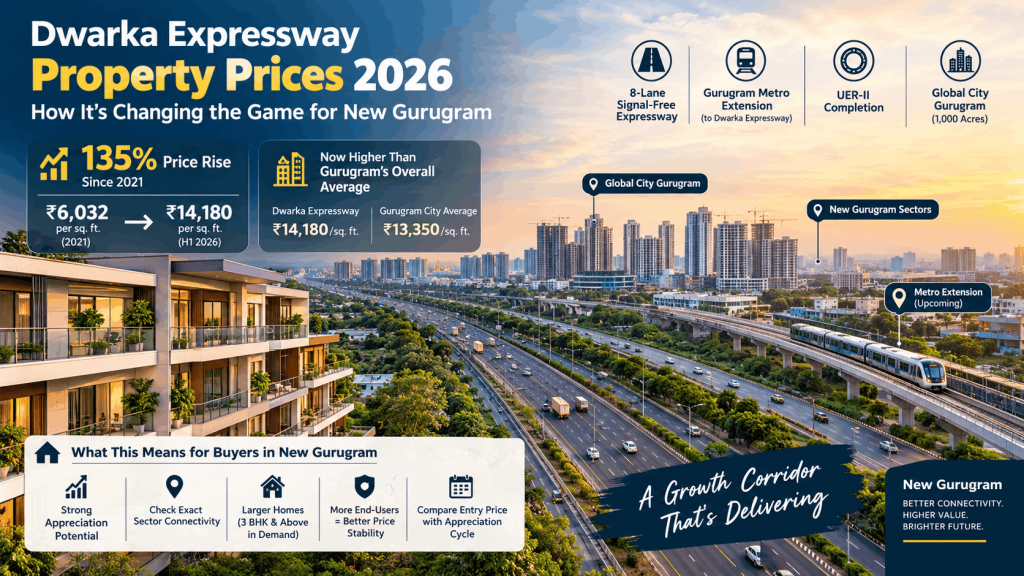
According to an Anarock Research & Advisory report from September 2026, residential prices along Dwarka Expressway have risen 135% since 2021, moving from around ₹6,032 per square foot to ₹14,180 per square foot in the first half of 2026. That’s not a gradual climb. That’s a corridor that’s roughly doubled and then some in under five years.
What’s more telling is the comparison. Dwarka Expressway’s average residential price is now higher than Gurugram’s overall city average of ₹13,350 per square foot in the same period. A stretch that used to be considered peripheral has pulled ahead of the city it belongs to.
What’s Actually Driving This
This isn’t appreciation happening in a vacuum. The expressway itself, an 8-lane signal-free corridor connecting Delhi to Gurugram, has fundamentally changed how people think about commuting from this belt. But the growth story goes beyond just the road.
The proposed Gurugram Metro extension toward Dwarka Expressway, the completion of UER-II, and the 1,000-acre Global City Gurugram all point toward another leg of growth. Better connectivity here tends to fuel employment-led housing demand. Infrastructure like this tends to compound. Each new piece — a metro line, a ring road, a business district — makes the next wave of development more attractive than the last.
Circle Rates Are Catching Up Too
The Haryana government recently raised circle rates by nearly 67% across key sectors, from approximately ₹40,000 to ₹70,000 per square yard. That’s the government’s own valuation acknowledging what the market has already been pricing in for a while.
For buyers, this means the corridor’s “cheap entry point” phase has largely passed. Prices, both market and official, have moved substantially, and real infrastructure delivery is driving that shift, not speculation about promises that haven’t materialized yet.
What This Means for New Gurugram Sectors Specifically
Sectors that sit within or near this corridor benefit from the same connectivity halo, even if their individual price movements haven’t matched the expressway’s headline numbers yet. That gap is often where the opportunity sits. A sector one ring further out from the core expressway frontage frequently sees its own appreciation cycle a year or two behind the leading pockets, once infrastructure and demand spill outward.
Demand along this belt has also been shifting toward larger homes, with three-BHK and larger configurations making up the majority of new supply between 2021 and the first half of 2026. That tells you the buyer profile here isn’t purely investors chasing appreciation. A significant share are families planning to actually live in the area long-term, which tends to support price stability rather than the volatility you see in purely speculative markets.
Should This Change How You Evaluate a Purchase Here?
If you’re comparing plots or builder floors in New Gurugram, treat proximity to this corridor’s growth story as a genuine factor, but not the only one. Check how directly connected a specific sector actually is to the expressway and upcoming metro link, rather than assuming “New Gurugram” as a label guarantees the same trajectory everywhere.
Also weigh entry price against how much of the appreciation cycle has already played out. Getting in at the very start of a corridor’s growth story captures the biggest gains. Getting in after prices have already run up significantly still works, but the math looks different, and it’s worth going in with clear eyes about that.
Final Thought
Dwarka Expressway didn’t become one of India’s best-performing residential corridors by accident. Real infrastructure arrived, connectivity genuinely improved, and demand followed. That pattern is now pushing outward into the sectors around it, New Gurugram included. Whether you’re buying now or planning to over the next year, understanding where your specific plot sits relative to this growth wave is one of the most useful things you can check before signing anything.
keywords: New Gurugram property appreciation, Dwarka Expressway connectivity 2026, Gurugram circle rate 2026, Global City Gurugram, Gurugram metro extension, Sector 95 Dwarka Expressway proximity